
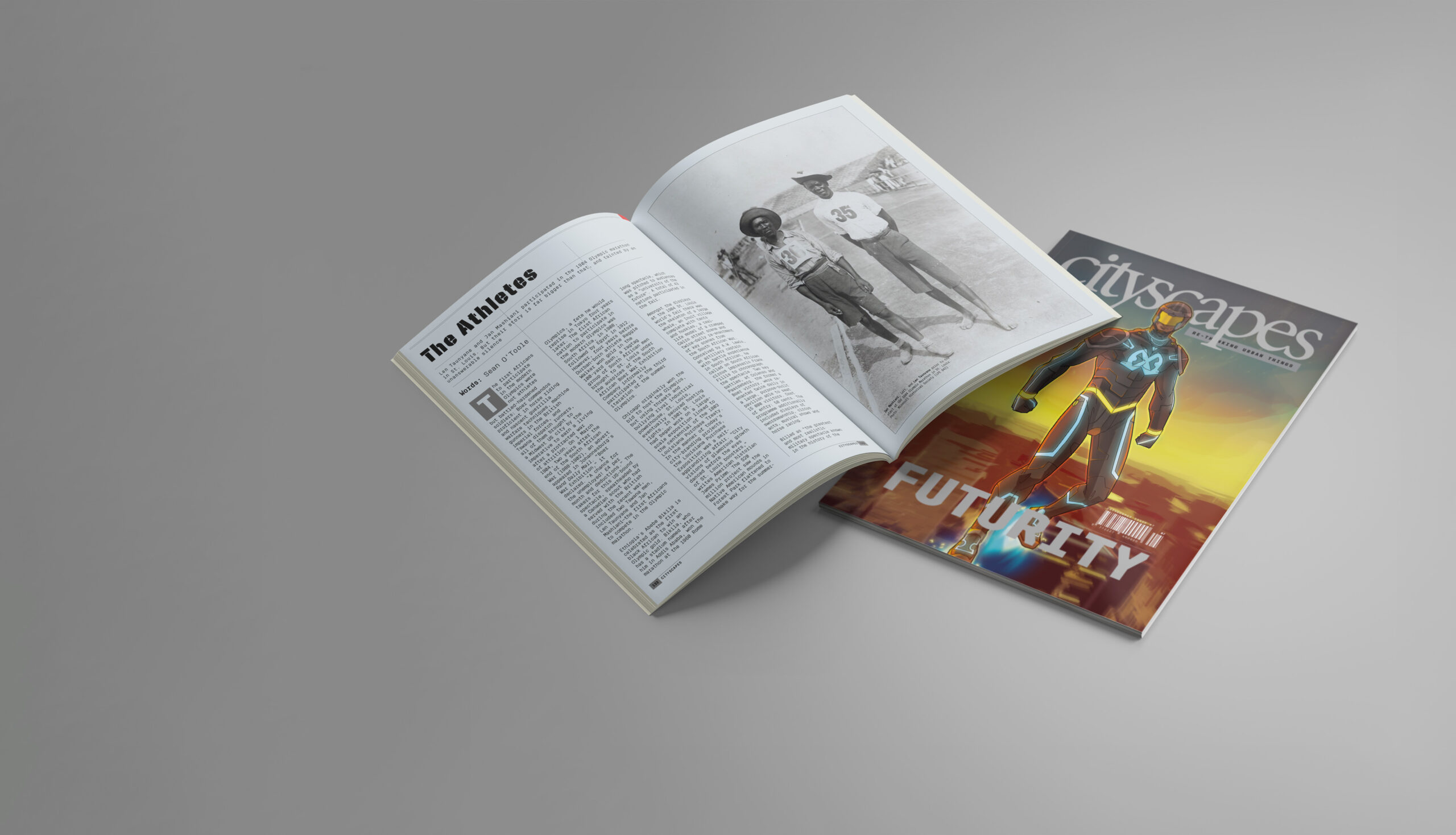
#7
Futurity
Issue #7 of Cityscapes Magazine explored how the future is imagined by urbanites and urban thinkers across Africa, Asia, and Latin America. Philosopher Achille Mbembe; writer Robert Neuwirth; architect, and science-fiction writers Nnedi Okorafor and Lauren Beukes feature.
In January 2015 the African Union adopted Agenda 2063, a vision statement and action plan for a prosperous and united Africa. Agenda 2063 is historically mindful but in essence focussed on the future. “We aspire that by 2063, Africa shall be a prosperous continent, with the means and resources to drive its own development, and where: African people have a high standard of living, and quality of life, sound health and well-being,” reads a passage from this document.
Cities and other settlements are a point of elaboration. By 2063, the AU projects, they will be hubs of cultural and economic activities, with “modernized infrastructure” and “basic necessities of life” such as shelter, water, sanitation, energy, public transport and—given it is the post-digital world we are speculating about—information and communications technologies.
But what does it mean to imagine the future from the vantage of the present? What does the past tell us about the future? Are the musician Fela Kuti’s prison thoughts still relevant? In 1984, the military-backed regime of General Muhammadu Buhari, currently Nigeria’s democratically elected president, jailed Kuti on trumped-up charges. Speaking to a Dutch music journalist, Kuti prophesised a bleak future. “Nigeria is not a producer,”he said. “You could say the same thing for Africa as a whole and that’s why it will continue to go downhill.”
The reason: material production. “We do not produce anything that is needed in the world. Just oil.” Music? “Oh please stop. Music might be able to be an economic aid for Africa, but we are not in urgent need of that kind of production. We must produce raw things that people want and must buy. Only then will things improve for Africa. But as long as that doesn’t happen, what does Nigeria’s development plan stand for? Nothing. Just oil. And everyone has oil nowadays, because the Arabs are selling more oil than the world can use.”
Africa is a continent poised between aspiration and actuality. This future-minded edition of Cityscapes is framed around the rubric of “futurity”. This noun has an uncomplicated meaning: it denotes future time, and speaks about renewed or continuing existence.
Future time occupies us all. What will tomorrow be like? It will be urban and unequal.
suggest our contributors. In Africa, some inhabitants will live in gated compounds, others in congested informal living arrangements. There will, of course, be trade and exchange, reciprocity and collaboration. The continent will also, in various forms and diverse ways, bear the imprimatur of China. “Whatever the case, China has, for now, become a far more prominent actor than others in the future-making of Africa,” writes philosopher Achille Mbembe (p.50), “to the point where Africa is now not only a planetary question … but also and more specifically a Chinese question.” Various contributors debate and complicate his assertion. Technology, that panacea of technocrats and sci-fi geeks, is also debated. It will refigure Africa, but not in the ways necessarily figured by marketers of smart technologies and exotic financing tools. Just two of a number of jump-off points into this issue.
Good reading…

On African youth and deferred opportunity
Alcinda Honwana
On refugee settlements and new paradigms
Kilian Kleinschmidt
On smart cities and new urban imaginaries
Maarten Hajer
On China and Africa’s variegated urbanism
Philip Harrison & Yan Yang
On favelas, green spaces and progressive cities
Pedro Henrique de Cristo & Caroline Shannon de Christo
On urban aspiration and city identity
Robert Neuwirth
The Magic Kingdom
Remodelling Johannesburg’s urban edge
Out of the dumps
Dar es Salaam struggles with its solid waste
Recycling while cycling
Urban waste sponsors innovation in Lagos
No more ghosts
Ghosts city outside Luanda comes to life
An energetic opportunity
Africa’s pending renewable energy revolution
Anatomy of a failure
A smart city idea goes awry in Tshwane
Housing in Addis
Housing shortage in Africa’s political capital
Under construction
Street life in Addis Ababa
Africa’s new century
The planet’s destiny depends on Africa
Waiting…
Portraits of people quietly waiting
Inclusive cities
A conversation with urbanist Alfredo Garay
Johannesburg’s future
A conversation with Mayor Parks Tau
Kinshasa’s holes
AbdouMaliq Simone chats with Filip De Boeck
Pockmarked city
Kinshasa and its lapsed infrastructural dreams
Stealth practices
Informal public demands in urban Latin America
Unflinching witness
Drug abuse among Johannesburg’s unemployed youth
Adaptive reuse
Vestiges of old Maputo proudly endure
A double existence
Peter Mörtenböck and Helge Mooshammer on informality
A man of promise
Roye Okupe’s Lagos-inspired superhero rises
Science ≠ Fiction
Nnedi Okorafor and Lauren Beukes on narrative and science
Young Nigeria’s worldliness
Artist and designer Karo Akpokiere on drawing home, Lagos
The Athletes
Len Taunyane, Jan Mashiani and the 1904 Olympic marathon
Sammy Baloji
Filipe Branquinho
Marcelo Corti
Sylvia Croese
Teddy Cruz
Caroline de Christo
Pedro de Cristo
Filip De Boeck
Mary Anne Fitzgerald
Fonna Forman
Maarten Hajer
Philip Harrison
Alcinda Honwana
Kilian Kleinschmidt
Jason Larkin
Patrick Latimer
Megan Lindow
Lesley Lokko
Achille Mbembe
Robert Neuwirth
Tolullah Oni
Joshua Palfreman
Tanya Pampalone
Edgar Pieterse
Demian Rotbart
AbdouMaliq Simone
Lindokuhle Sobekwa
Graeme Williams
Yan Yang

