
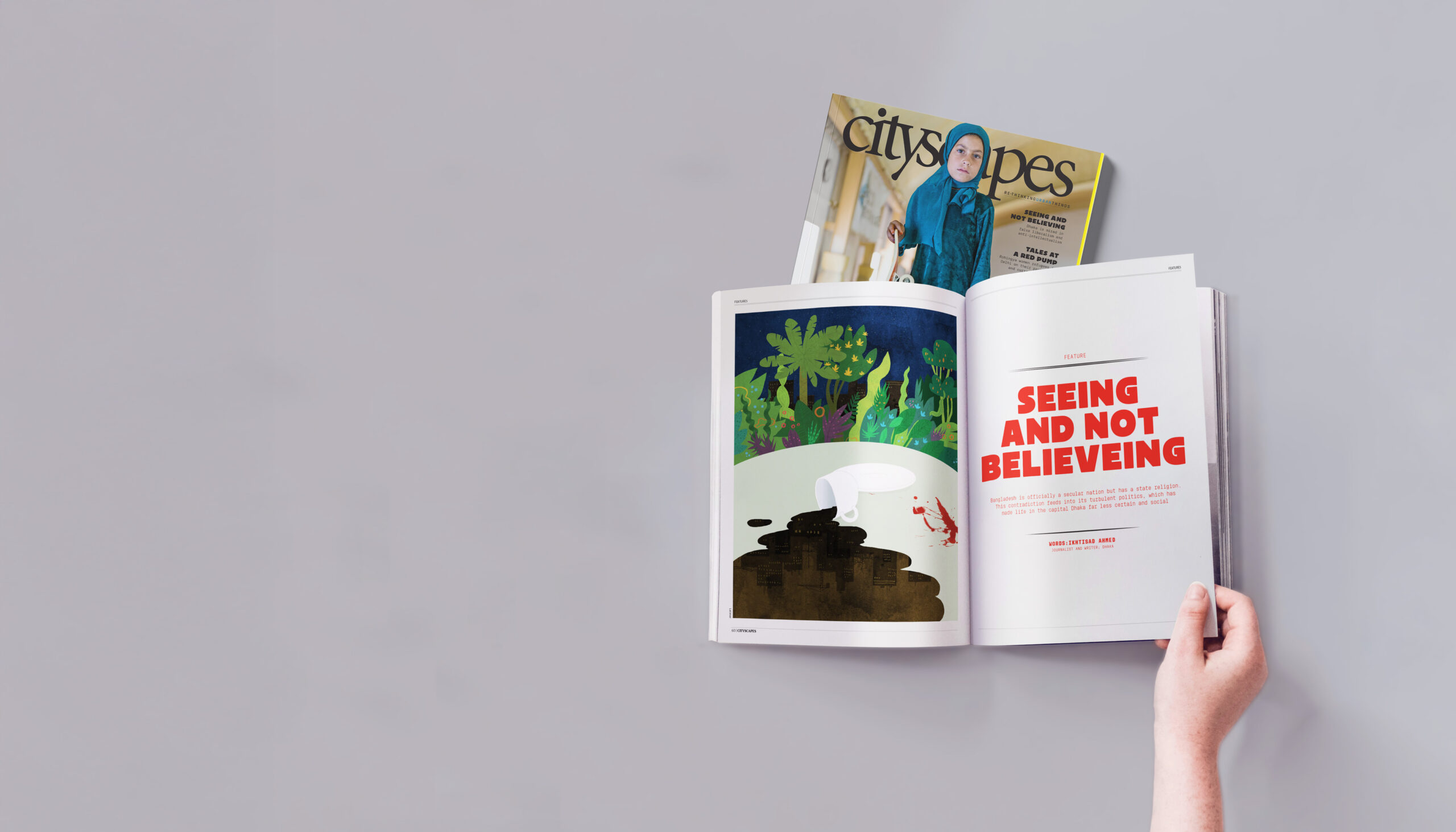
#8
Asia South
With a focus on South Asian cities, issue #8 brought together strong writing from journalists, researchers, activists, and others across the region—from Dhaka to Peshawar, Delhi to Kathmandu.
People move. That is what we do. We move our bodies, move house, neighbourhood; we move across and through borders. We move because we want to and sometimes because we need to. To be with or away from family, to adventure and experience new things, on pilgrimage, to escape, learn, and sometimes to return home when it calls us. We move through space, we move up (becoming wealthier, more affluent), down (becoming materially more impoverished), we also move ideas and resources. We move to work, to search, to find, and sometimes to lose.
We move… It’s in our nature and has been since time immemorial.
Yet, as the world becomes better connected, moving has become a challenging and divisive experience at every scale you can imagine. We are building and strengthening physical borders to keep those we feel are “not worthy” from occupying the same spaces we do, while inviting the “desirable” – the educated, “clever”, connected, wealthy and talented – in.
Our interest is in where people move to, and why. Also, how ideas and capital circulate, traverse borders, and what the impacts are once “there”. This is the reason we have produced this issue.
The ninth issue of Cityscapes and our new tagline—Urbanism Beyond Geography—marks a re-launch, after a hiatus (of sorts).
As the abundance of figures being released on the topic attests, we have been moving to cities – everywhere. The magnetism of places larger than where we are from has attracted legions – for centuries – and is now just part of the human story. Cities are not a new construct, and moving to them is really not that new a phenomenon. What’s different is the scale. In many economies, cities are the places where opportunities lie, where dreams can be fulfilled—or dashed, but still given a chance—if you’re one of the lucky ones. We will always move to such places. Some inner instinct demands that we do.
What we have to figure out is how we live together once we get there. How the resources we have can be more equitably shared, and what we do when they are not. What do we do when the assets we have fuel distributional conflicts, understandably, with those who have been dealt a bad hand and have little to lose?
We have dug up stories that explore the nature(s) of movement, the impact it has on how we live and who we are, as well as the lives that are made – be they mobile or immobile – after the passage. It seems we move so that we are able to move some more. We move so we can “do better”, jump from one station in life to another. We become mobile hoping that it will expand our choices and send us ever onward.
Between these covers, we have tried to explore the question of what happens when we move to where we desire, or leave where we cannot be any more. In a “new” place, whether it’s for the short or long haul, how do we keep the ideas we hold dear? How do we, as “newcomers”, maintain the cultures that define us? How can we embrace our new situation in a manner that changes both us and our new settings?
Often, the “new” is old too. It seeks to hold on to its idea of self and wants to be loved and embraced on its own terms. It does not want to lose itself to the influence of newcomers – reinforcements of sorts – that, willingly or not, are its lifeblood.

On words that fail in unequal cities
Matias Echanove & Rahul Srivastava
On Delhi’s state water utility
Gautam Bhan
On urban resilience in Afghanistan
Jolyon Leslie
On assertive Muslim women in Karachi
Nida Kirmani
Saving Bangalore life-sustaining lakes
Rekha Raghunathan
When growth outpaces sustainability
Kashef Chowdhury
Xenophobia and violence against African Immigrants in Delhi
Tau Tavengwa
A multi-million dollar ghost town in Hambantota
Maryam Azwer
How sustained conflict is reshaping Peshawar—Pakistan’s oldest city
Words: Iftikhar Firdous
India’s higher education crisis
Kavya Murthy
Watching Traffic
Kabul’s gridlocked roads tell a distinctly Afghani story of violence and escape
Taran N. Khan
Majority World Image
Zeeshan Khan speaks to Shahidul Alam about photography, education and social activism
Tales At The Water Pump
Rohingya women from Myanmar talk about past lives and current struggles.
Neha Dixit
Seeing And Not Believing
Contemporary Bangladesh is mired in false liberalism and anti-intellectualism
Ikhtisad Ahmed
Shaggy Dog Stories
Reports on life, labour and dancing after dark at three Karachi graveyards
Musharraf Ali Farooqi
Musclemen, airplanes, tanks and other sculptural embellishments in rural Punjab
Rajesh Vora
A girls-only skate session at Skateistan’s sport and education project in Kabul
Jessica Fulford-Dobson
Finding Kashmir’s cadence of resilience, seeing the quiet faith that binds
Amit Mehra
A ramble through Yangon, where life is marked by casual urgencies
Aun Raza
Cinema, Not Software
Animator Gitanjali Rao on filmmaking, Cannes and a curious selfie project. Words: Arpita Das
A Walk On The Wild Side Of Calcutta
Calcutta’s musical history is a huge tree with many branches
Rupleena Bose
A Death In The Family
Why the Nepalese magazine Himal Southasian abruptly stopped printing in 2016
Puja Sen
Ikhtisad Ahmed
Shahidul Alam
Maryam Azwer
Gautam Bhan
Rupleena Bose
Kashef Chowdhury
Arpita Das
Neha Dixit
Matias Echanove
Musharraf Ali Farooqi
Iftikhar Firdous
Jessica Fulford-Dobson
Taran N. Khan
Zeeshan Khan
Nida Kirmani
Jolyon Leslie
Amit Mehra
Rekha Raghunathan
Gitanjali Rao
Aun Raza
Puja Sen
Rahul Srivastava
Rajesh Vora

