

#4
After Informality
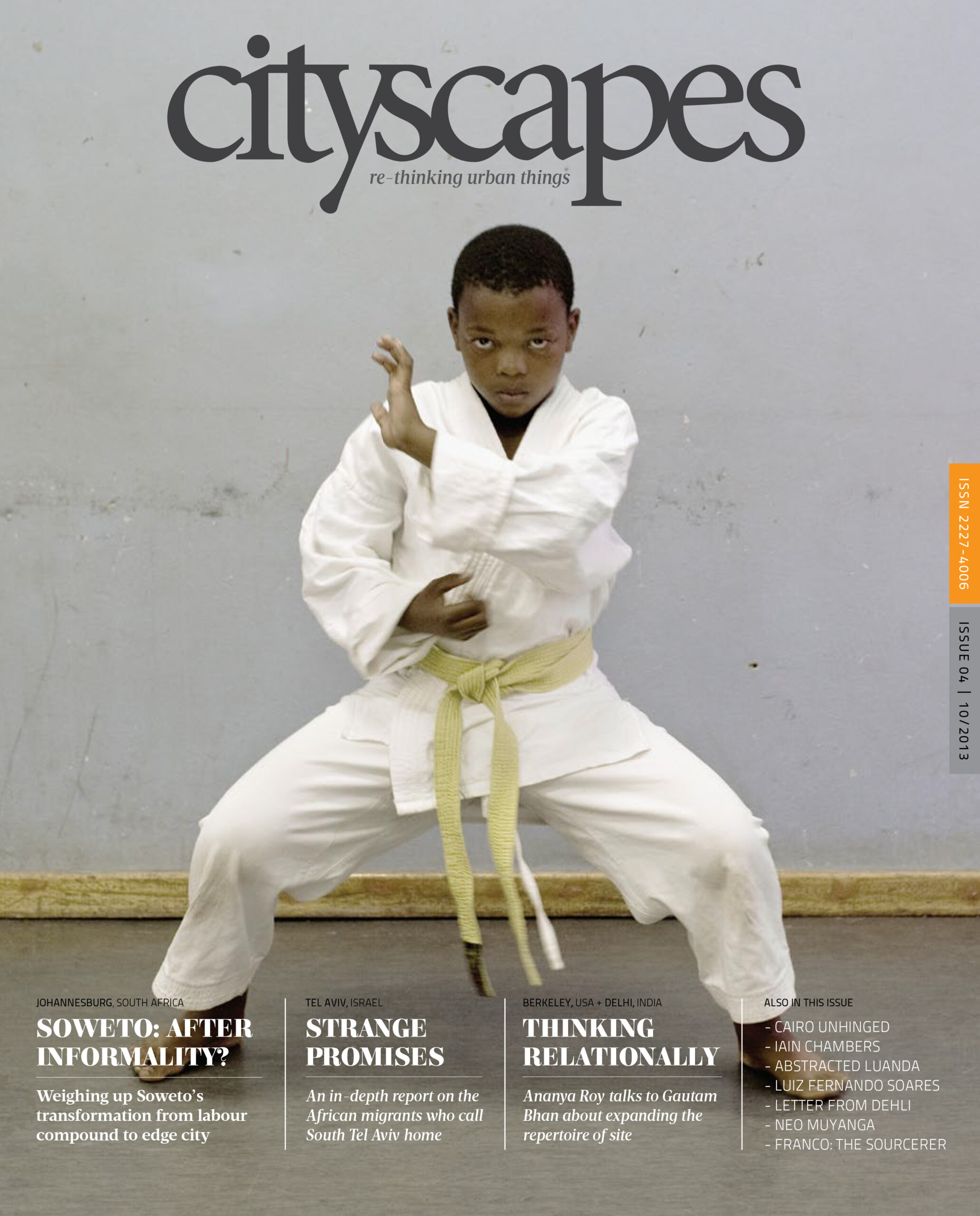
From Joseph Dana’s piece on the treatment and systemic racism faced by black, jewish immigrants in Tel Aviv, to Yepoka Yebo’s sprawling investigation into the lives of Nigerian immigrants in Guangzhou, China, this edition of Cityscapes magazine was our first foray into deep journalism. It all featured a big piece on Soweto’s post-apartheid transformation.
Winter has a way of clarifying Johannesburg’s urban landscape, especially those interstitial spaces—the abandoned mining projects, dumpsites for suburban building waste, fenced-off grasslands and fragile wetlands—that typically insert themselves between the city’s many labour ghettoes and saw-tooth-roofed industrial townships. Walking paths cut across these open spaces like etchings on a copperplate. Best viewed from the air, these “desire lines” upend the logic of linear planning. The product of hard luck and urban suss, they trace the quickest route between here and there. Search them out. Walk southwest out of Johannesburg, through Riverlea and the poisoned mining landscape there, towards Diepkloof and the dense cluster of domesticity beyond, Soweto. This issue tackles Soweto. Is it a viable model of what happens after informality? The question does not propose a simple answer. Soweto’s redevelopment is uneven. There are malls, loft developments, a theatre, and more. Significantly, there are roads and basic services. Change is afoot, but not for all.
Which brings us back to those ephemeral footpaths. Modesty is not part of Johannesburg’s DNA. Roads are not simply roads: they are politics. In May, the city announced a ten-year plan to invest R100 billion in infrastructure projects—“corridors of freedom” they have been officially dubbed—that will challenge the hegemony of the private car. The historical moment should allow for some concessions, but as Soweto’s burgeoning car-wash shops and unmapped footpaths suggest, the city’s big plans are awkwardly positioned between two diverging realities. In a city of endless sprawl a car matters, big time. But while some Sowetans now drive, many still walk—oftentimes to bus stops, taxi ranks and train stations, but also along gravel tracks that connect basic needs with unknown possibilities. The roving logic of the walker pervades this issue. A grouped series of reports, essays and interviews trace a zigzag path connecting Tel Aviv to Naples to Berlin to Guangzhou, all cities where African migrants are a feature of the urban matrix. It is not simply an exercise in aggregation. There is a speculative logic at work. In her conversation with Gautam Bhan in this issue, Ananya Roy conjectures, “what does it mean for us to think relationally about the north and south, recognising that these are connected geographies in all sorts of ways?” The question informs this issue’s contributions by Iain Chambers, Laura Gottesdiener and Garth Myers. “The tangible outcomes from rethinking a rust belt US city from African perspectives might seem at first to be ephemeral,” writes Myers. City learning is a two-way street, he offers. Right on.
Good reading…
Trouble in the Promised Land
As many as 60,000 African migrants, many from Eritrea, live and work in Israel, often in exploitative circumstances
Little Lagos in Big China
Life in Guangzhou, southern China’s oldest trading city, is not just about making money for its community of West African traders
Soweto: After Informality?
Since 2000, Soweto has entered a new phase in its history. It is currently the site of intense government intervention. Where once it was a poorly serviced labour ghetto, Soweto is now being transformed into something nearing a vibrant edge city. But at what cost? To what end? And for whose benefit?
Private investment in Soweto is still selective
Kirsten Harrison
Soweto’s Cinderella status ignores basic truths
Ngwane + Bond
The great American credit rip-off
Laura Gottesdiener
The end of Brazilian political apathy
Luiz Fernando Soares
The past visits the now through song
Neo Muyanga
Lessons from African urbanism for US
Garth Myers
Being fearless in critique and proposition
Edgar Pieterse
Inside the world’s tallest slum
Daniel Schwartz and Iwan Baan take us inside the Centro Financiero Confinanzas, an incomplete 45-story skyscraper in Caracas, Venezuela, that was occupied by squatters and is currently home to about 2500 people
Lessons from somewhere
Ananya Roy, a professor of city and regional planning at the University of California, Berkeley, is well known for her scholarship on microfinance and poverty alleviation. She talks to former student Gautam Bhan about fashioning a relational urban theory that is cognisant of the role of place
Credibility is everything
Togolese-Canadian novelist Edem Awumey gives his first English-language interview
Cliches in the City
How a series of short films about African cities confirm and challenge stereotypes
People of the Sky
Guy Tillim talks about his time recording life in Joburg’s cramped high-rise apartments
Island of Exception
A thriving commercial centre in south Delhi, Hauz Khas Village is notorious for its vibrant nightlife and unscrupulous landlords
Franco: The Baritone
Franco, the godfather of Congolese rumba, skilfully negotiated change and tyranny in Zaire with guitar and song
Iwan Baan
Gautam Bhan
Jodi Bieber
Patrick Bond
Guillaume Bonn
Edson Chagas
Iain Chambers
Joseph Dana
Kimon de Greef
Fred de Vries
Dan Eckstein
David Goldblatt
Laura Gottesdiener
Kim Gurney
Kirsten Harrison
Leon Krige
Joonji Mdyogolo
Neo Muyanga
Garth Myers
Trevor Ngwane
Ananya Roy
Daniel Schwartz
Luiz Eduardo Soares
Samanth Subramanian
Yepoka Yeebo

