

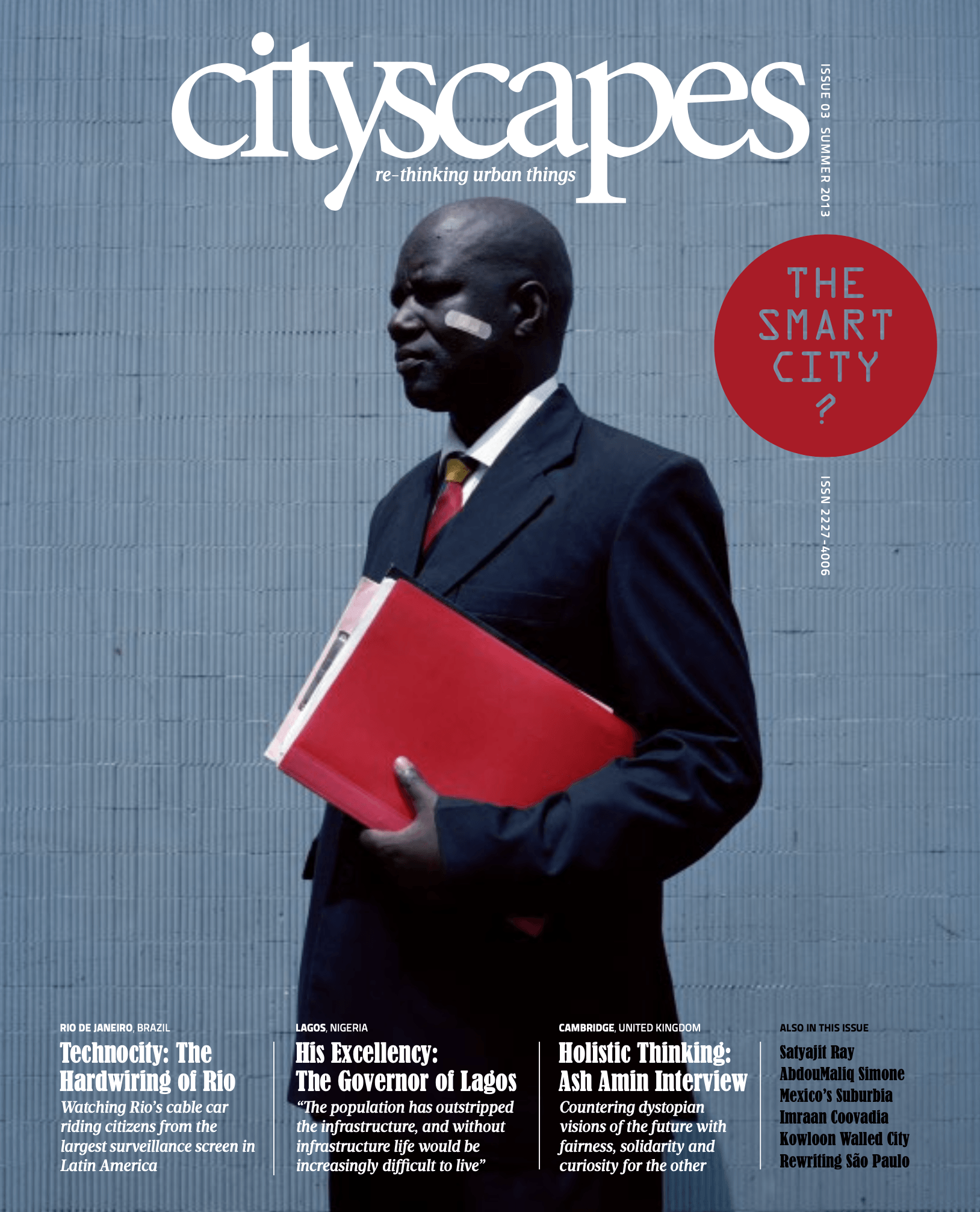
#3
The Smart City?
In the years leading up to 2012, the phrase “Smart City” was everywhere—and meant something different depending on who was using it. Issue #3 set out to interrogate that slipperiness: what the term actually signified, how it manifested on the ground, and why the dissonance mattered.
This issue, our third, looks at the “smart city” idea. This appellation is increasingly gaining traction in global discourses of urban planning and public administration, despite a widely held sense that it lacks adequate definitional clarity. Practice being the crucible of meaning, we look at a number of real world contexts—notably Rio de Janeiro and Dhaka—for possible perspectives. What is clear is the increasing faith city administrators are placing in networked information and communications technologies capable of interpreting vast, intangible and temporal sets of mathematical data to implement the top-down managerial ordering of large-scale urban phenomenon. The draw of doing business this way is simple. “Technology gives you a faster response,” explains Dario Bizzo Marques, a technology systems coordinator at Rio’s $14-million integrated city management centre (see p.58), home to Latin America’s largest surveillance screen. The inevitability of doing things this way is not without quandaries. “We increasingly share the space and time of cities with semi-autonomous agents of a nonhuman, indeed non-biological, nature, from drones to algorithms,” offers Adam Greenfield in a provocative 100-point manifesto (see p.24). “The grandeur in determining the conditions of urban existence increasingly resides with those who produce networked objects and services, and the interfaces to them.” Greenfield’s contribution serves as a useful primer, not least for drawing attention to the latent ideological assumptions underpinning the smart city idea. Ash Amin, in his interview with Matthew Gandy (see p.86), is similarly interested in what it means to reduce city management to the marshalling of abstract data. “The positivist legacy has been rekindled in the ‘big data’ approach to the city,” he offers. “Its conceit is to think that the availability of sophisticated mathematical models able to work large data in nuanced ways, allows the city to be visualised and understood in all its complexities and evolving changes.” It is not the only way to critique the smart city idea. In his editorial, crime researcher Hennie van Vuuren highlights the huge payday new African megacities will (and already do) offer to criminal syndicates (see p.18). Take Johannesburg, whose highways are the busiest in Africa. As part of its massive road infrastructure upgrade project, South African National Roads Agency (SANRAL), an independent statutory company solely owned by the government, implemented a host of “intelligent transport systems” to manage traffic flows. A solution was desperately needed: a 2010 report on 20 key global cities undertaken by IBM found Johannesburg’s roads only marginally worse than Beijing and Mexico City. SANRAL’s solution: an integrated system comprising significant in-situ hardware, including electronic vehicle identification readers, CCTV cameras and variable message signs, all linked to a network management centre by fibre optic cables. Criminal syndicates have ruthlessly targeted this physical infrastructure. “We don’t know what to do anymore,” said a senior project manager at SANRAL in 2009.
The smart city idea may not always represent the panacea its boosters promise, but its apparent inevitably as a management tool makes it a crucial topic for research.
Good reading…
TECHNOCITY
City managers everywhere are increasingly leveraging information and communication technologies in a bid to make decisive city-scale interventions in city design, housing, mobility, energy delivery and other areas of proactive and reactive metropolitan governance. Welcome to the “smart city”, a data-driven approach to urban design and planning. We visit Rio de Janeiro as well as invite four experts to offer lateral perspective
The Many Labours of Babatunde Fashola
Babatunde Fashola, a soccer-loving former lawyer, is the thirteenth governor of Lagos State and de facto mayor of the city of Lagos, one of the largest urban areas in the world. His infrastructural initiatives have been hailed as a “rare example” of civic leadership
Constant Code Switching in Cape Town
Theaster Gates, a Chicago-based artist with concurrent qualifications in urban planning, religious studies and ceramics, remembers his days in Cape Town: “I was a temporary prince and struggled to figure out how to share with friends and how to come off my princely high when it came time to leave”
Scopics of Urban Neglect
Distinguished urbanist Ash Amin discusses the contemporary neglect of the urban poor and their infrastructural rights with Matthew Gandy
AbdouMaliq Simone
Endurance as a strategy for negotiating lack
Criminal elites and African megacities
Hennie van Vuuren
Addressing informal workers in cities
Caroline Skinner
Participation as a force of social transformation
Edgar Pieterse
The smart city benefits only managerial elites
Adam Greenfield
On fibre-optic and public wi-fi infrastructure
Steve Song
Smarter cities will invest in human resources
Jay Bhalla
Urban motorisation and Bangladeshi cityscapes
P. Christopher Zegras
The end of the steel-and-petroleum car system
John Urry
The Kigali Conceptual Master Plan and the idealised transformation of Rwanda’s capital
Killian Doherty
Rawabi, Palestine’s first planned city, looks strangely like a mountaintop Israeli settlement
Joseph Dana
A walk through Kibera
Caroline Kihato
The only time it is quiet in Lagos is when the electricity fails
Julian Röder
Cairo’s wealthy are building dream homes in the desert
Jason Larkin
The Filmmaker
Revisiting the work of Satyajit Ray, the masterful Kolkata-born director who engaged multiple lives and experiences
Rewriting the City
How São Paulo’s ubiquitous graffiti and pixação are subverting notions of power and authorship
Plastic Freedom and Architectural Inventiveness
Remembering Oscar Niemeyer, the man who learned “a good many things” reading the letters of Lenin and Chekov
A Life on the Fringe
Alejandro Cartagena wanders through the suburban sprawl of Monterrey
Hong Kong Circa 1990
Inside Kowloon Walled City, a multi-story tenement once home to 30,000 people
Ash Amin
Jay Bhalla
Clare Butcher
Teresa P. R. Caldeira
Alejandro Cartagena
Liza Cirolia
Joseph Dana
Lloyd DeGrane
Ore Disu
Killian Doherty
Matthew Gandy
Greg Girard
Caroline Wanjiku Kihato
Jason Larkin
Kyle Morland
Julian Röder
Julie Ruvolo
Viviane Sassen
AbdouMaliq Simone
Jai Arjun Singh
Caroline Skinner
Steve Song
Hennie van Vuuren
Blain van Rooyen
P. Christopher Zegras

