
- In 2025, we worked with Urban2063, a coalition of 13 organisations convened by our long-term partners—African Centre for Cities. All member organisations of the coalition work towards achieving equitable and sustainable urbanisation globally.
- Targeted at the year-long series of activities that culminated in the G20 Summit hosted by South Africa (and for the first time on the African continent) the objective of the project was clear: to ensure that African urban realities were not treated as peripheral, but as structural to economic growth, infrastructure finance, climate response, and social stability, and full recognition that cities will play an integral role in determining the future of African nations.
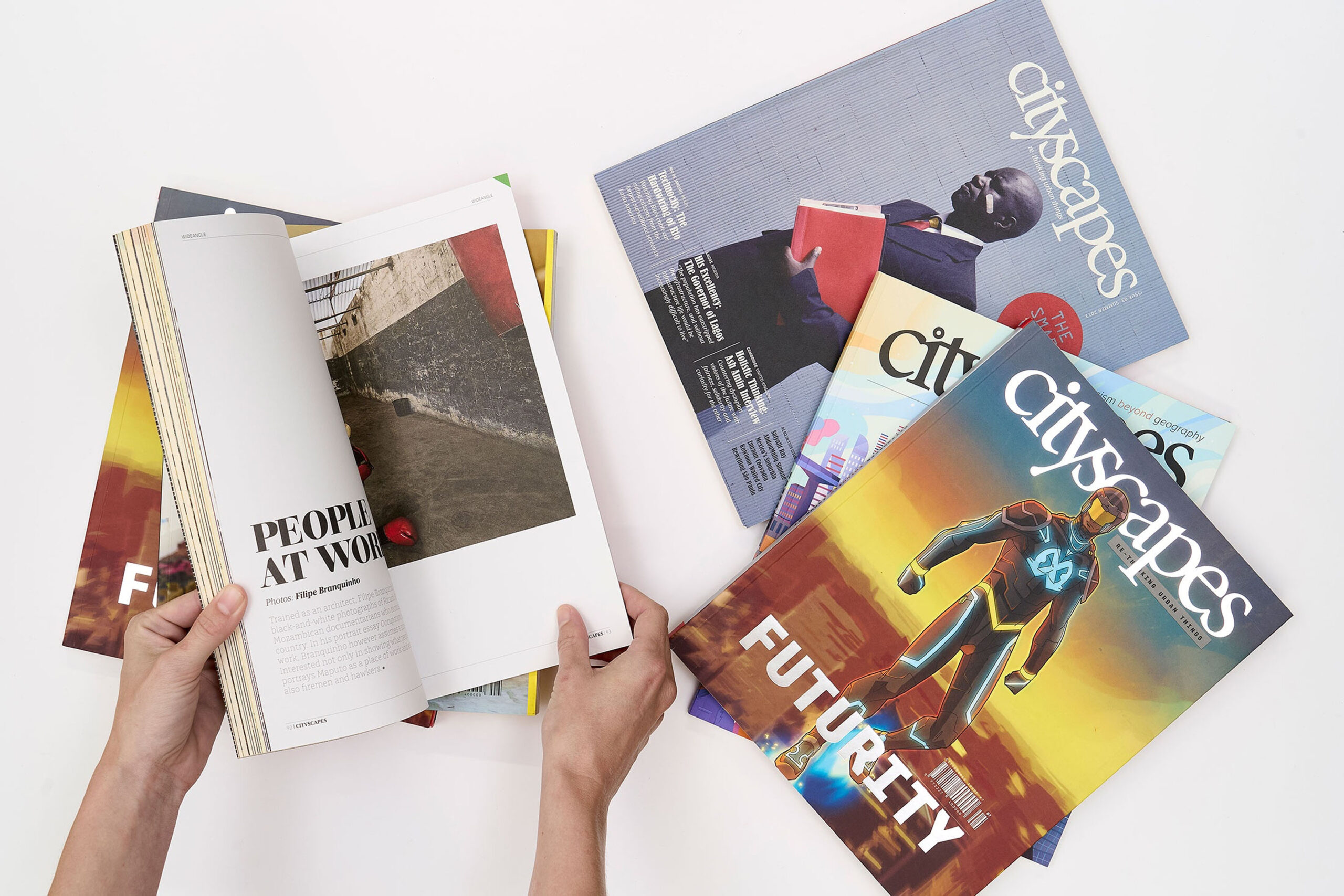
- The work combined research that led to the production of a series of eight policy briefs, a 90-page Cityscapes Magazine special report, a 3-episode scripted podcast series, a series of webinars, and coordinated media aimed at increasing public discourse on the role of cities and the policy debates which are a core part of the G20 Summit.
- Cityscapes has steadily mutated into something altogether different—a range of forms that extends well beyond the printed page, seeding exhibitions, podcasts, convenings, and a variety of related projects. In doing so, it’s built a network that genuinely cuts across professions and geographies, connecting practitioners, researchers, and cultural producers working on urban questions around the world.
- Over time, the project has helped shape and consolidate a distinct Global South perspective on what cities actually are and what they might become—quite deliberately challenging the Western ideas that continue to dominate much of the global urban conversation.
- The experimental character of Cityscapes has been fundamental to how it’s developed. The publication has consistently treated media, research, and cultural production not as fixed outputs, but as tools for inquiry—allowing ideas to move between formats and contexts, to travel and take on new life. This approach has generated genuine collaborations across disciplines and institutions, whilst also revealing entirely new ways of documenting and interpreting urban change.
- In this sense, Cityscapes became more than a magazine. It established the ethos that now guides CS Studio’s work: an open, exploratory practice that weaves together storytelling, research, design, and convening to examine how cities are shaped—and how they might be remade and reimagined.
- More than 15 years of Cityscapes have reinforced something fundamental: there is no singular narrative through which all cities can be understood. There’s no one idea of what a city is, or should be. Urban life is layered, contested, and deeply contradictory. Try to impose a single story and you flatten the very complexity that makes cities actually work—and that shapes how people genuinely live.
- We’ve also learnt that there’s genuine value in encountering ideas, practices, and experiences that challenge what you thought you knew—that unsettle established thinking. But we’ve learnt, too, that the terms of these encounters are constantly shifting, never quite settling.
- Cityscapes has taught us that friction isn’t something to avoid. When different disciplines, geographies, and perspectives collide, the tension that results can open up far more interesting questions and possibilities. It’s not always comfortable, and that’s precisely the point.
- It’s forced us to fundamentally rethink what publishing actually means, and to resist the pull of conventional formats. Print, exhibitions, podcasts, film, gatherings, experiments—each allows different dimensions of how we’re thinking about urban life and the built environment to come into view. Each reveals what a single format might have hidden.
- And perhaps most importantly, we’re learning that uncertainty isn’t a weakness. Accepting it—sitting with it—opens space for genuine curiosity, for adaptation, for entirely new ways of understanding and working.

