
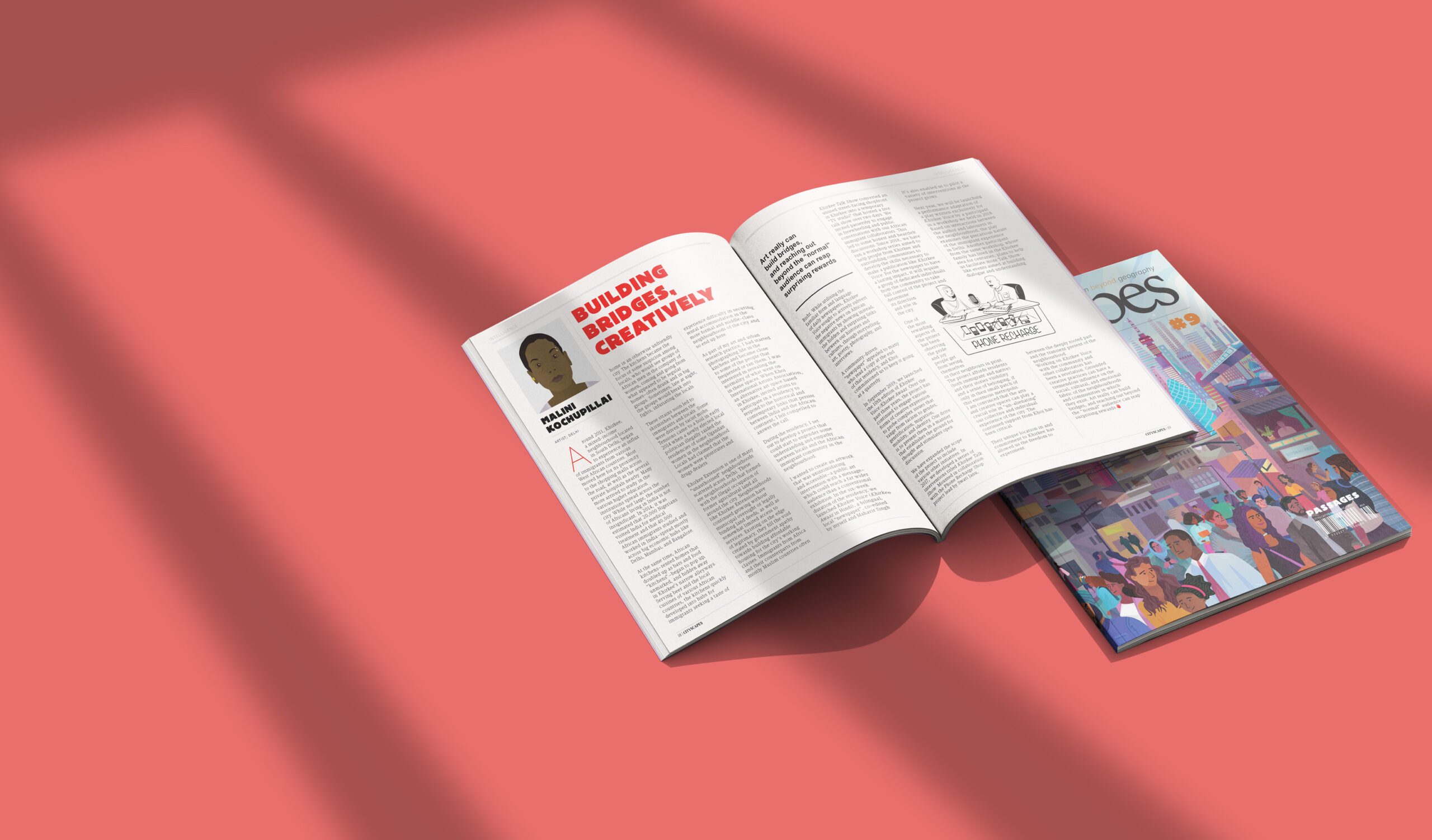
#9
Passages
Focused on movement and mobility, issue #9 featured writing by former National Geographic editor Matthew Shirts, who spent time with Brazilian activist Carmen Silva; writer Yepoka Yeebo, attended the first Notting Hill Carnival in the shadow of the Grenfell Tower fire. Samanth Subramanian spoke with Suketu Mehta about immigrant life in Donald Trump’s America.
People move. That is what we do. We move our bodies, move house, neighbourhood; we move across and through borders. We move because we want to and sometimes because we need to. To be with or away from family, to adventure and experience new things, on pilgrimage, to escape, learn, and sometimes to return home when it calls us. We move through space, we move up (becoming wealthier, more affluent), down (becoming materially more impoverished), we also move ideas and resources. We move to work, to search, to find, and sometimes to lose. We move …
It’s in our nature and has been since time immemorial.
Yet as the world has become better connected, moving has become a challenging and divisive experience at every scale you can imagine. We are building and strengthening physical borders to keep those we feel are “not worthy” from occupying the same spaces we do, while inviting the “desirable” – the educated, “clever”, connected, wealthy and talented – in.
Our interest is in where people move to, and why. Also, on how ideas and capital circulate, traverse borders, and what their impact is once “there”. This is the reason we have produced this issue. This ninth issue of Cityscapes Magazine and our new tagline marks a re-launch or re-awakening of sorts, after a hiatus.
Lately, as the abundance of figures being released continuously on the topic attests, we have been moving to cities – everywhere. The magnetism of places larger than where we are from has attracted legions – for centuries – and is now just part of the human story. Cities are not a new construct, and moving to them is really not that new a phenomenon. What’s different is the scale. In many economies, cities are the places where opportunities lie, where dreams can be fulfilled or dashed but still given a chance (if you’re lucky). We will always move to such places. Some inner instinct we share demands that we do.
What we have to figure out is how we live together once we get there. How the resources we have can be more equitably shared, and what we do when they are not. What do we do when the assets we have fuel distributional conflicts, understandably,with those who have been dealt a bad hand and have little to lose?
We have dug up stories that explore the nature(s) of movement, the impact it has on how we live and who we are, as well as the lives that are made – be they mobile or immobile – after the move. It seems we move so that we are able to move some more.
We move so we can “do better”, jump from one station in life to another. We become mobile hoping that it will expand our choices and send us ever onward.
Between these two covers, we have tried to explore the question of what happens when we move to where we desire, or leave where we cannot be any more. In a “new” place, whether it’s for the short or long haul, how do we keep the ideas we hold dear? How do we, as “newcomers”, maintain the cultures that define us? How can we embrace our new situation in a manner that changes both us and our new settings?
Often, the “new” is old too. It seeks to hold on to its idea of self and wants to be loved and embraced on its own terms. It does not want to lose itself to the influence of newcomers – reinforcements of sorts – that, willingly or not, are its lifeblood. They are what renew it over and over again.

Gang Woes
Cape Town’s violence epidemic
Narrowing Passageways
Immigrants in the UK’s inner cities
Building Bridges, Creatively
Art with a mission
Home, and Away
Growing up immigrant in America
Untethered Practice
The need for located practice
Keeping Karachi Moving
Unlikely connections
Empty, not Lifeless
Karachi’s empty lots
A Scanner, Darkly
Getting to work in Jakarta
Going Up!!!
Mumbaikas rediscover civic participation
Monstrous Profits
Venezuelan refugees in Medellín
Carmen Silva
Her continuing fight for São Paulo’s roofless
Little Mogadishu
Joburg’s Somali community
Suketu Mehta
The Truth Teller
A Politics of Connection
Tatiana Thieme speaks to Elena Fiddian Qasmiyeh
Carnival Remembers
The Notting Hill Carnival after Grenfell Towers
Gang Related
Gang life in Managua and Cape Town
China Biscuit
Losing, and finding Identity
More than Money
The rising power and unexpected impact of remittances
Re-imagining the City from the Inside Out
Omar Nagati on working with possibilities in post-revolution Cairo
Noir
Msingi Sasis’ essay Nairobi Noir casts a light on night-time in the city
Terminus
Madagascan photographer Miora Rajaonary meets the locals in Yeoville, Joburg
Walking While Black
Garnette Cadogan on the privilege and perils of m walking as a black man
Imaginary Republics
Sean O’Toole on the history of Joburg’s informal watering holes
Mercy Brown-Luthango
Suzi Hall
Emanuel Admassu
Malini Kochupillai
Tomà Berlanda
Nausheen Anwar
Kevin Shi
Andesh Tomo
Vyjayanthi Rao
Victor Vargas Rodríguez
Samanth Subramanian
Tatiana Thieme
Matthew Shirts
Yepoka Yeebo
Lee Middleton
Robert Neuwirth
Msingi Sasisi
Miora Rajaonary
Garnette Cardogan
Sean O’Toole
Isaac Diggs
Tatiana Fernandez Geara
Tanya Zack
Mark Lewis

