
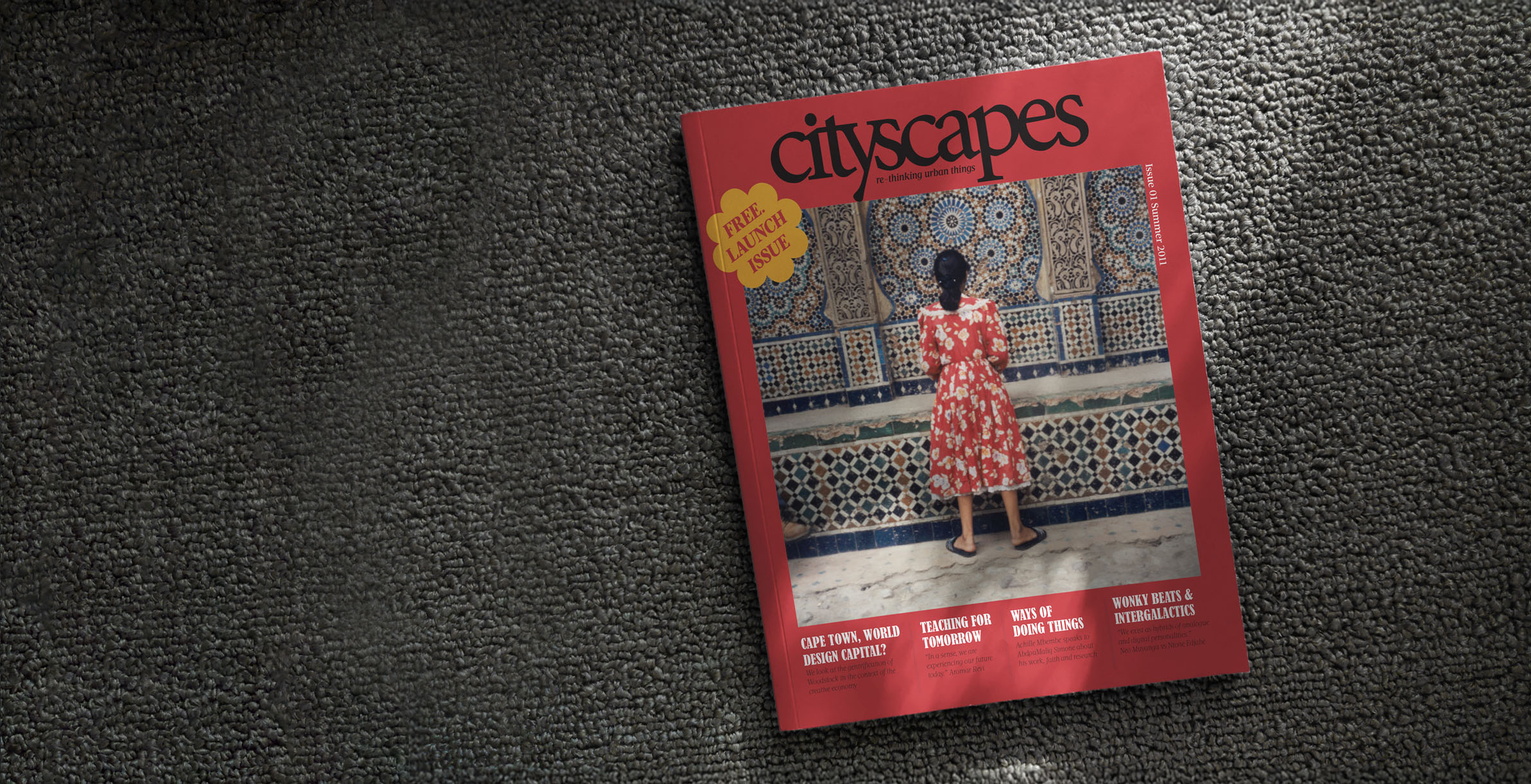
#1
Launch issue
The inaugural issue of Cityscapes Magazine was a first attempt at what felt like a near-impossible project. Largely on goodwill and favours, it brought together writing from fellow travellers who believed in what we were attempting to accomplish.
Somewhere in these 120 pages—on page 70 actually, or thereabouts—musician and composer Neo Muyanga speaks of a complexity he describes as “more akin to elegance”, a complexity about “getting to a space where you understand the deeper links between divergent points”. Elsewhere in this new addition to the mediascape—on page 14, to be exact—Edgar Pieterse, our colleague and a guiding force behind the establishment of CityScapes, speaks of how this publication needs to constantly navigate between dystopia and hope. Adopting a singular, pedantic position is therefore not enough.
Turn quickly to page 38. (Welcome back.) That is Indian photographer Dhruv Malhotra. Between 2007 and 2009 he walked contemporary Delhi, by night. His photographs picture just a fraction of the megacity’s inhabitants, finding shelter in the shadow of its opulent structures, claiming their share of the city’s promise, however tenuous.
These three things—a transcript of an interview, an editorial, a photo essay—all herald the same thing. “They all connect to each other.” (That’s Aromar Revi, speaking with Edgar on page 55.) The keyword here is connect. Although engaged in very different practices, all three the highlighted examples illustrate the idea that everything, no matter how disparate and unrelated it may seem, is connected. CityScapes is interested in exploring, finding and mapping those connections. In the last few months we have spent a not inconsiderable amount of time ferreting around for ideas and opinions, also looked hard for practices that animate our guiding philosophy. This new magazine is the outcome of that activity.
We mentioned the word philosophy just a moment ago. CityScapes has a philosophy. Actually, it’s a pretty simple statement of intent. CityScapes is founded on the belief that the African city, like cities elsewhere, is a multi-form, multi-storied and multi-nodal organism. Rather than present a priori assumptions, the magazine assumes the position that knowledge is empirical and accretive, plural not singular, a constellation of possibilities rather than a set of known variables. Inquiry is not an end. The very act of inquiry produces a new destabilisation and reconfiguration, which demands further inquiry. Underpinning this editorial remit, which we spent many months arguing over and refining, is a series of basic, if philosophically directed questions:
- What is the role of the city, as an intellectual and social construct, in our earth’s future?
- How does academic study impact urban transformation?
- How does practice impact urban transformation?
- How do macroscopic and microscopic readings change our understanding of the city?
- Can a dialogue between academics and those in practice in various urban-centric fields yield a new understanding of the dynamism of southern cities?
- What do we learn when we compare discrete experiences from different geographies on the African continent and the global south?
- Can a notionally difficult argument be presented non-verbally as a photographic essay or reinterpreted as information graphic?
This is our first shot at answering these questions.
Good reading…

Remaking African universities
Edgar Pieterse
Investing in India’s urban potential
Jessica Seddon
SA’s fragmented urban islands
Camaren Peter
Late night dancing in Djibouti
Olufemi Terry
Media silence in DiepslootMedia silence in Diepsloot
Anton Harber
Radio, the Nigerian way
Lagos, Nigeria
Bullfrogs with Attitude
An extract from Anton Harber’s new book on Diepsloot, where a bullfrog forms part of Johannesburg’s urban class wars
Tangerine Dreams
Moroccan photographer Yto Barrada, winner of the 2011 Deutsche Bank Artist of the Year Award, on collecting and reading
A happening city, culturally
Kinshasa, DRC
Geography and the revolution
Cairo, Egypt
The hope of public transport
Johannesburg, South Africa
Repurposing the old trash heap
Medellín, Colombia
The Civil Engineer
Hebert Macaulay, the father of Nigeria’s struggle for political freedom, had a horizontal moustache parallel to the equator line
Wonky Beats
“We exist as hybrids of analogue and digital personalities.”Neo Muyanga vs Ntone Edjabe
Teaching For Tomorrow
“In a sense, we are experiencing our future today.” Aromar Revi
Cape Town, World Design Capital?
We look at the gentrification of Woodstock in the context of the creative economy
Ways of Doing Things
Achille Mbembe speaks to AbdouMaliq Simone about his work, faith and research
Akin Adesokan
Negar Azimi
Laurence Bonvin
Alejandro Echieverri
Kim Gurney
Anton Harber
Megan Lindow
Druv Malhotra
Achille Mbembe
Zayd Minty
Tolu Ogunlesi
Jessica Seddon
Janine Stephen
Mikhael Subotsky
Olufemi Terry
Eve Thompson
Ivan Turok
Patrick Waterhouse
Previous

